
The Faces Hidden in Plain Sight
A mystery buried beneath Europe’s crowns, churches, and painted walls

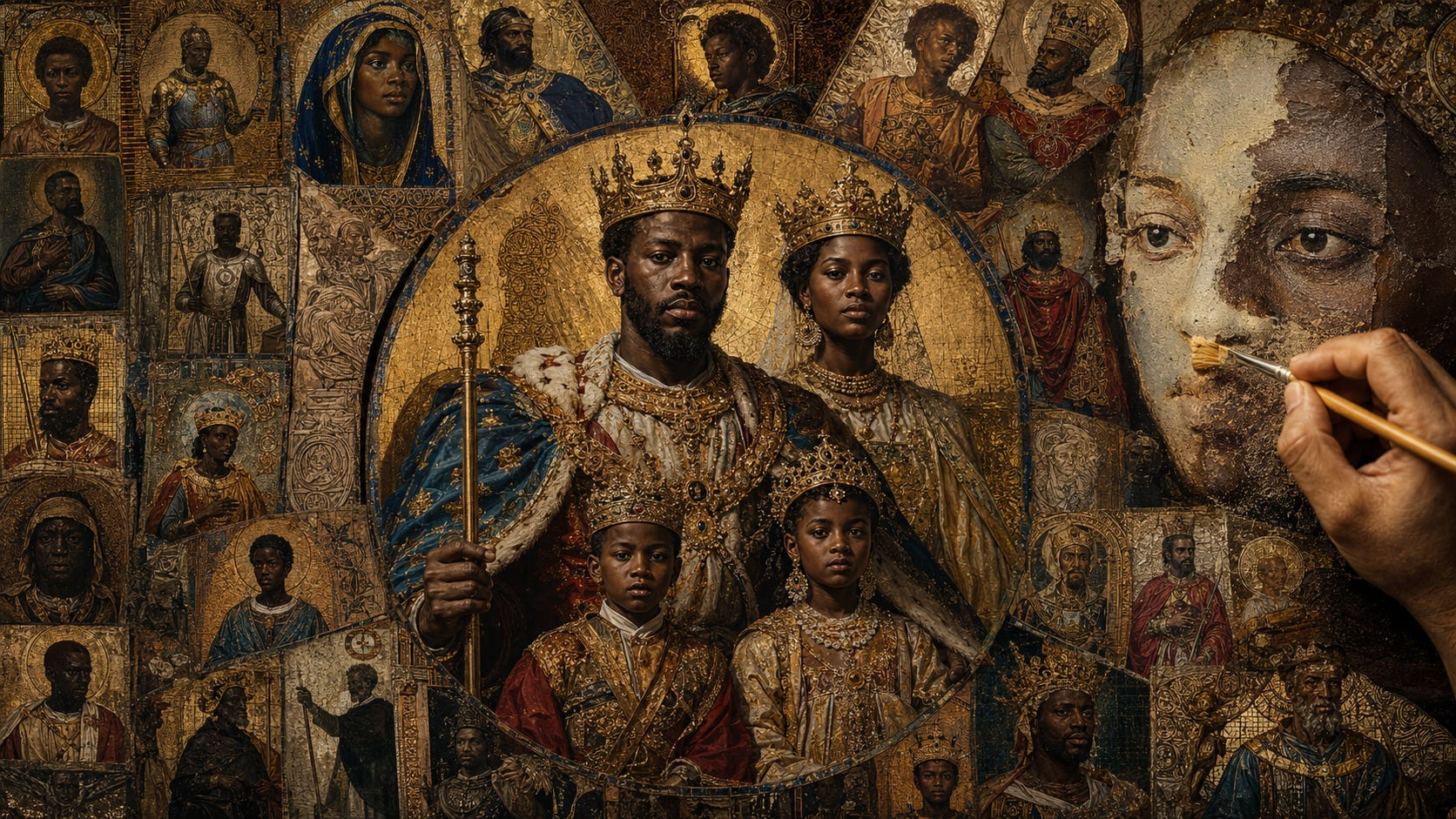
Walk into a cathedral in Germany or Spain that was already old when your country was an idea. The air is cold. The stone has been holding the same temperature for nine hundred years. The walls are covered with the faces the builders wanted remembered forever: saints, kings, soldiers, prophets, martyrs. Painted eyes that have watched forty generations file past and die.
Look a little longer. Some of those faces are Black.
They are not in chains, not carrying someone else’s luggage, not tucked behind a throne to make the man sitting on it look taller.
They are wearing crowns. Some carry swords. Some wear armor, robes, jewels, and the garments of the church. Some have halos. Some stand beside the king. Some appear to be the king.
The moment you see them, the questions start, and they do not stop. Who were these people? Why did someone with a brush and a wall and a lifetime of work decide to put them there? Why do their faces show up in churches, royal courts, manuscripts, sculptures, and payroll records across an entire continent? And why did so many of us grow up certain they were never there at all?
The picture we were handed
Most of us received a finished version of European history before we were old enough to ask who painted it. Medieval Europe was white. Renaissance Europe was white. The kings, the saints, the scholars, the soldiers, the inventors. All white. Black people entered the story on schedule, in chains, right around the time slavery and colonialism needed explaining.
That version is tidy. It is also missing a great deal.
Start with Balthazar. One of the Magi who came to see the infant Jesus. Over the centuries, European artists increasingly painted him as a Black African king. Not a servant in the background. A ruler, carrying wealth, dressed in the clothes of authority, standing among the first people on earth to recognize the birth of Christ. Nobody put a Black king inside Christianity’s most sacred scene by accident. They were reflecting a world where Africa was tied into trade, diplomacy, faith, money, and power.
Then there is Saint Maurice. Remembered as a Roman commander and a Christian martyr. By the thirteenth century, artists were carving and painting him as a Black African knight. In armor. Armed. Standing like a man who expects to be obeyed. He was not slipped into the sacred picture as a gesture. He was presented as the ideal Christian soldier, the model, the one you were supposed to want to be.
The statues are still standing. The paintings are still hanging. The churches still open on Sunday. The mystery is not where the evidence went. The mystery is how the story around it got so unfamiliar.
The man standing next to the king
Leave the artwork and go into the accounting records, where people rarely lie for free.
John Blanke played trumpet in the courts of Henry VII and Henry VIII. He is not a theory. He is a line item. In December 1507, the Treasurer of the Chamber paid “John Blanke the Blacke Trumpet” 20 shillings, and kept paying him month after month. Twelve pounds a year, roughly double a farm laborer and triple a servant. He was issued mourning cloth for Henry VII’s funeral and scarlet for Henry VIII’s coronation. He is painted twice into the Westminster Tournament Roll of 1511, riding with the other trumpeters.
Then he did the thing that still stops me cold. He wrote to the king.
Around 1512, Blanke petitioned Henry VIII for the position left open by a dead trumpeter named Dominic Justinian, and asked for his pay to be doubled from 8 pence a day to 16. He also asked for it backdated to the first of December. The parchment survives in the National Archives. You can read his argument: his wages were “not sufficient to mayntaigne and kepe hym to doo your grace lyke service as other your trompetors doo.” Translated out of Tudor English, he was saying he was doing the same job as everyone else and getting paid less for it, and he wanted it fixed.
Henry VIII signed it. Blanke got the raise and the back pay. That same year the king ordered a wedding gift for him out of the Great Wardrobe: violet cloth, a lined doublet, scarlet hose, a hat, a bonnet.
Sit with the confidence that took. A Black musician in Tudor England looked at his pay stub, decided he was worth double, and took it to a man who was famously bad at hearing the word no. He negotiated. He won. He got married.
Generations of students learned what Henry VIII ate, who he married, who he killed, and how wide he eventually got. Almost none of them learned about the man playing the trumpet in the room. History kept the dinner menu and lost the musician. That is not a gap in the record. That is a decision about which records mattered.
Blanke was not the start of it either. Centuries before him, an African scholar named Hadrian became abbot of a major monastery in Canterbury and helped build the intellectual life of Anglo-Saxon England. Other records carry Black musicians, merchants, sailors, laborers, soldiers, and residents moving through European towns. They were not time travelers. They were part of the world that was already there.
The Black Duke of Florence
Alessandro de’ Medici ruled Florence during the Renaissance. He belonged to the family that bankrolled half of European art, brokered popes, and bent politics around its money. Alessandro had African ancestry. He was known as the Black Duke of Florence.
Not standing near that dynasty. Not serving it. Running it.
For years, plenty of descriptions of Alessandro simply left that part out, or waved at it and moved on. Which is how this usually works. Nobody has to burn the archive. Nobody announces the edit.
A museum drops one sentence from a placard. A textbook drops one name. A film casts a century without a single face that would complicate it. A teacher passes along exactly what she was taught, because she has 140 students and no reason to doubt the book. A kid grows up and never knows there was anything missing. Give it long enough and the omission puts on a suit and starts calling itself the truth.
The Moorish question
The biggest argument is over the Moors. In 711, forces from North Africa crossed into Iberia, broke the Visigothic kingdom, and established societies that governed large parts of what we now call Spain and Portugal for centuries. They built cities, libraries, markets, universities, palaces, and gardens. They kept and advanced work in mathematics, astronomy, medicine, philosophy, agriculture, and architecture. That is not a footnote to European history. That is European history.
The trouble starts when we try to force every person called a Moor into one modern racial box. The word moved around. It meant Muslims. It meant North Africans. It meant Arabs. It meant Amazigh people. Sometimes it just meant foreign and darker than the person writing it down.
So no, not every Moor would be called Black today. It is also dishonest to scrub Blackness and African identity out of the story entirely. North Africans were central to the leadership, the armies, the scholarship, and the daily life of those societies. Sub-Saharan Africans were present too. Some were soldiers. Some were merchants. Some were free. Some were enslaved. Some gave orders.
Did Black people rule all of Europe for eight hundred years? No. Europe was not a country. It was a moving mess of kingdoms, empires, church territories, city-states, and alliances that changed with the weather. But African and Muslim governments did rule significant European territory for centuries. Black individuals did hold real power. African people were woven into European political, religious, military, and intellectual life.
The biggest version of the claim reaches too far. What is underneath it is still remarkable.
When power changed hands
In 1492, the last Muslim kingdom in Iberia fell, and what followed was not a handshake. Muslims who stayed were pressured to give up their religion, their language, their clothing, their names. Many were forced to convert. The converts were then watched, interrogated, and punished for secretly keeping the traditions they had been ordered to abandon. Eventually many were expelled. Others were enslaved. Families came apart. Mosques became churches. Languages thinned out and died in one or two generations.
Think about what happens to a people who are conquered, renamed, converted, scattered, and taught to hide. The buildings survive. The stories do not. The bloodlines continue while the identity is deleted. Their descendants can be standing on the same ground, speaking the language of the people who took it, with no idea what is sitting inside their own family.
That is not a fringe theory. That is one of the oldest tools power has.
The images
The darkest questions are about the religious art itself. During the Byzantine iconoclasm, sacred images were covered, broken, and destroyed while church leaders fought over whether holy images should exist at all. The destruction is documented. What is not documented is the claim that the whole movement was built to erase a Black Jesus.
Dark-skinned images of Christ, Mary, and the saints did exist. Some reflected the people around the artist. Some followed local tradition. Some got darker from smoke, age, varnish, and failing pigment. Some were repainted. Every image has its own history, and it has to be argued one image at a time.
A dark face does not automatically prove African identity. A lighter restoration does not automatically prove a conspiracy. We should also be honest that some people will explain away every dark sacred image until Blackness becomes structurally impossible, which is its own kind of tell.
What we can say is this. Religious images were destroyed. Dark religious figures existed. Works were altered, copied, damaged, restored, and cut loose from their meaning. We will never know how much was lost. That uncertainty does not close the case. It is the case.
The women in the margins
This was never only a story about Black men.
Their records are thinner because history was mostly written by powerful men keeping track of other powerful men. Women, servants, laborers, migrants, and the enslaved rarely got to leave anything behind in their own voice.
In 1521, Albrecht Dürer drew a young Black African woman named Katharina. We know her name. We know she was about twenty. We know the household she lived in. We can look directly into her face.
We do not know where she was born, what she wanted, who she loved, what frightened her, or whether she ever got free. Her face survived. Her voice did not. That gap tells you as much as the drawing does.
Black women lived in European cities, courts, households, markets, and churches. Some free, some enslaved. Some became wives and mothers. Some were worked to nothing. Some appear in paintings as decoration standing next to a wealthy European, positioned like furniture with a pulse. They were not only erased from power. Their names, their work, their children, their refusals, and their ordinary Tuesdays were erased too.
What is true, what is worth asking, and what goes too far
Some of this is settled. Black people were in Europe long before the colonial era. They lived in its cities, worked in its courts, served in its churches and armies, played its music, and taught in its schools. Black saints and African kings hang on European walls. African and Muslim governments ruled European territory for centuries. A ruler of Renaissance Florence had African ancestry. That is not conspiracy. That is history.
Some of it is a live question. How many dark images were altered, damaged, misidentified, or badly restored? How many people called Moors would today be called Black, North African, Arab, Amazigh, or something our racial categories cannot hold? How much African influence got minimized once colonialism required Africa to look primitive? How many Black women vanished because the record kept the name of the man who owned, employed, painted, or punished them, and dropped hers?
Some of it goes too far, and saying so protects the rest. No single Black population ruled the whole continent. Iconoclasm cannot be reduced to a plot against a Black Jesus. Every dark figure in medieval art is not automatically African. Two traditions that resemble each other are not automatically related. We do not fix a false history by building a second one. Black history does not need the exaggeration. It is already heavy enough to carry.
The real erasure
The greatest discovery here is not that Black people secretly wore every crown in Europe. They did not need to. They were already there. Already building, ruling, praying, negotiating, teaching, raising children, and getting paid.
The real erasure was the invention of a Europe so completely white that finding one Black saint, one Black duke, one Black trumpeter with a signed raise, now feels like uncovering a conspiracy instead of reading a receipt.
When I say the Black experience, I mean rulers and servants. Saints and soldiers. Scholars, mothers, musicians, laborers, believers, captives, survivors, and people nobody bothered to name. It was never one story, one class, one country, one shade, or one gender. It was a vast human experience stretched across borders, centuries, faiths, and empires.
History did not erase every Black face. It did something more efficient. It trained us not to see them.
So why?
Here is the question I cannot put down. Erasure at that scale is expensive. It takes centuries, institutions, artists, teachers, printers, and money. Nobody spends that on an accident. So what was it buying?
You cannot enslave a people your children have been taught were kings. You cannot colonize a continent your churches have been painting as holy. You cannot build an economy on the idea that Africans are cargo while a Black African king kneels at the manger in your cathedral and a Black African knight stands at your altar in armor. The math does not work. So the kings had to go first.
Erasure is not the aftermath of oppression. It is the permit. It gets pulled before construction starts. Take the crowns off the wall, take the names out of the ledger, and by the time the ships sail, everyone involved can believe they are doing something other than what they are doing.
Which brings me to the part that keeps me up.
In March 2025, an executive order titled “Restoring Truth and Sanity to American History” put the exhibits and programming of Smithsonian museums under review, including the National Museum of African American History and Culture, and directed the National Park Service to remove content that “inappropriately disparage Americans past or living.” In January 2026, Park Service staff took down the slavery exhibit at the President’s House site in Independence National Historical Park in Philadelphia, the ground where George Washington kept enslaved people while serving as president. Members of Congress sent a letter demanding to know why. This month, July 2026, the country celebrates 250 years since the Declaration.
I live in Florida. In 2023 this state adopted African American history standards for middle schoolers with a benchmark clarification instructing that “slaves developed skills which, in some instances, could be applied for their personal benefit.” Trades, they said. Blacksmithing. Carpentry. Tailoring. The state called the standards comprehensive. The American Historical Association asked a simpler question: what is the purpose of denying young people as much history as possible?
Be careful here, because the same discipline applies in both directions. When the São José slave ship timber came off display at the African American History Museum this March, it looked like part of a pattern. It was a loan agreement expiring and the artifact going home to South Africa. The museum said so plainly. If we are going to hold the line on evidence for a fifteenth century painting, we hold it in 2026 too.
But strip out the one that has an innocent explanation and the rest is still sitting there. A placard removed. A benchmark reworded. An exhibit crated up. A review of what a museum is allowed to say about the country in the year of its birthday party. None of it looks like burning books. It never does. It looks like editing.
That is what I recognize. Not the violence. The paperwork. The quiet trimming of one sentence, one name, one room, one artifact, until a generation grows up with a version of the story that is comfortable and incomplete, and has no idea anything was taken, because how would they.
So I will ask it the way it deserves to be asked. If erasure is always a permit, and it always gets pulled before construction starts, then what is being built?
Somebody went to enormous trouble to make sure you did not know about a Black trumpeter who talked Henry VIII into doubling his pay. That petition sat in an archive for 500 years with the king’s signature on it. It was never lost. It was just never mentioned.
Ask yourself what they are declining to mention now. Then go look at the wall.
Thanks for reading,
William Rochelle
But you can call me Bill.
#BlackHistory #AfricanHistory #EuropeanHistory #HiddenHistory #HistoricalErasure #MedievalHistory #RenaissanceHistory #BlackWomenInHistory #JohnBlanke #HistoryMatters #CriticalThinking #Florida